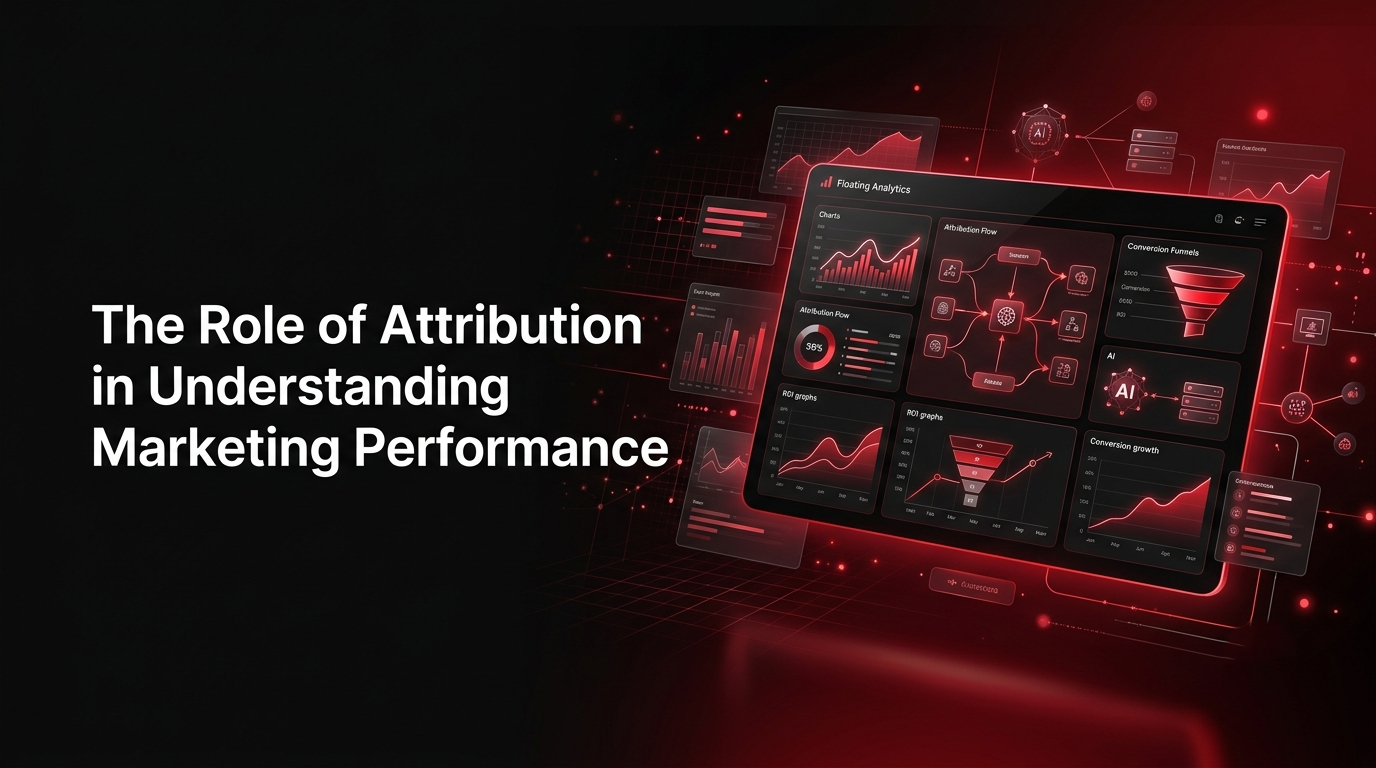
Marketing is no longer about running campaigns; it’s about proving impact with clarity. With customer journeys becoming more complex and privacy rules tightening, attribution has evolved from a reporting tool into a strategic growth engine.
Today, brands that understand attribution don’t just track performance; they predict, optimize, and dominate results.
The Shift: From Tracking Clicks to Understanding Customers
Attribution is no longer about “who clicked”, it’s about “what influenced.”
Traditional models focused on last-click wins. But modern attribution looks deeper into customer behavior, intent, and engagement patterns.
- Customers now interact across multiple platforms, devices, and timeframes
- Single-touch models fail to capture the real journey
- Brands are shifting toward holistic customer journey tracking
Over 82% of enterprises now use multi-touch attribution, reducing customer acquisition costs significantly.
Latest Trends in Marketing Attribution
The future of marketing performance is being rewritten right now.
1. Server-side Tracking is Becoming the New Standard
With increasing browser restrictions and the decline of third-party cookies, traditional tracking methods are gradually losing effectiveness. In response, server-side tracking is emerging as a more reliable and secure approach to data collection, ensuring greater accuracy across campaigns.
It also reduces dependency on third-party platforms, giving brands more control over their data. As a result, businesses are now focusing on building their own data infrastructures, allowing them to rely on owned, trustworthy signals rather than external sources.
2. First-party Data is the New Competitive Advantage
Own your data, own your growth.
With privacy regulations tightening, businesses are shifting toward first-party data strategies.
- Data collected directly from customers becomes more valuable
- Email, CRM, and website interactions gain importance
- Enables better personalization and attribution clarity
Attribution is moving from “perfect tracking” to “reliable owned signals.”
3. Rise of AI-Powered Attribution Models
From reporting past results to predicting future outcomes.
AI is transforming attribution into a powerful predictive intelligence system, enabling marketers to move beyond past performance and make future-focused decisions. Through machine learning, high-performing customer interactions are accurately identified, helping brands understand what truly drives results.
It also allows marketers to predict campaign success even before scaling, reducing risks and improving efficiency. With real-time optimization capabilities, strategies can be adjusted instantly for better outcomes. As a result, AI-driven systems can even forecast return on ad spend (ROAS) in advance, significantly enhancing decision-making and overall marketing performance.
4. Multi-touch Attribution Dominates the Market
Every touchpoint matters, not just the last one.
Modern marketing recognizes that conversions are never linear.
- Assigns value across the full customer journey
- Highlights hidden contributors like awareness campaigns
- Improves budget distribution across channels
Businesses using advanced attribution see up to 31% improvement in campaign ROI.
5. Privacy-first Attribution Models
Respect privacy, retain performance.
With evolving privacy laws and reduced tracking capabilities, attribution is undergoing a significant transformation. It is increasingly shifting toward aggregated and modeled data, allowing marketers to gain insights without relying on individual-level tracking. As a result, traditional user-level tracking is being replaced by privacy-safe analytics that prioritize data protection while still delivering meaningful performance insights.
At the same time, new frameworks such as causal attribution models are emerging, enabling brands to measure true impact without depending on personal data, making these approaches more sustainable and future-ready.
6. Cross-channel & Omnichannel Attribution
Customers don’t think in channels, so why should your data?
Modern consumers communicate through:
- Social media
- Search engines
- Offline interactions
Attribution now connects all these into a single unified journey.
Brands integrating omnichannel attribution achieve higher budget accuracy and better conversions.
7. Incrementality & Causal Attribution
Not all conversions are caused by your ads.
A major shift is happening from correlation to actual impact measurement, where the focus is on identifying what truly drives incremental growth. This approach measures the real contribution of marketing efforts, filters out conversions that would have occurred without any influence, and helps to eliminate wasting ad spend.
As a result, it ensures accurate performance evaluation based on genuine impact, rather than relying on inflated or misleading metrics.
8. Real-time & Predictive Analytics
Speed is the new competitive advantage.
Marketing decisions are no longer based on past data alone.
- Real-time dashboards guide instant optimization
- Predictive analytics forecasts campaign outcomes
- Helps brands scale faster with confidence
9. Attribution Beyond Marketing: Aligning Sales & Growth
Breaking operational gaps between marketing and revenue.
Attribution is now used to align marketing and sales teams, ensuring both functions work toward shared goals and outcomes. It helps track lead quality and customer lifetime value, providing deeper insights into long-term business impact.
Additionally, attribution enables brands to measure full-funnel performance, from initial awareness to final conversion. As a result, companies that adopt unified attribution systems often experience higher revenue growth and shorter, more efficient sales cycles.
10. Attribution in a Cookieless & AI-driven World
The rules changed, but the game continues.
With the decline of cookies and AI-driven search:
- Discovery is becoming more fragmented
- Attribution must adapt to AI-driven customer journeys
- Brands need structured data to stay visible
The future is about directional clarity, not perfect accuracy.
How Brands Can Win With Modern Attribution
Clarity builds confidence, and confidence fuels growth. To stay ahead in an evolving marketing landscape, businesses must invest in strong first-party data systems and adopt AI-powered attribution tools that deliver deeper insights. Relying only on last-click models gives you an incomplete view of performance.
To truly understand what drives results, you need to analyze the entire customer journey, as this helps you make more accurate and meaningful decisions. Therefore, continuous testing and optimization help brands refine strategies and maintain a competitive edge.
Turn Attribution Insights Into Real Business Growth With Webfolks
Attribution is no longer optional; it’s the foundation of smart marketing. But having data is not enough; you need the right strategy to turn it into results.
At Webfolks, we help brands decode complex customer journeys, implement advanced attribution models, and transform raw data into powerful growth strategies.
If you want to stop wasting budget, understand what truly drives conversions, and scale with confidence, it’s time to partner with Webfolks and take your marketing performance to the next level.