For years, marketing teams celebrated traffic.
More people clicked. Brand visibility expanded. Website traffic surged.
Dashboards looked impressive. Reports felt productive. But here is the uncomfortable truth. Traffic does not pay salaries. Revenue does.
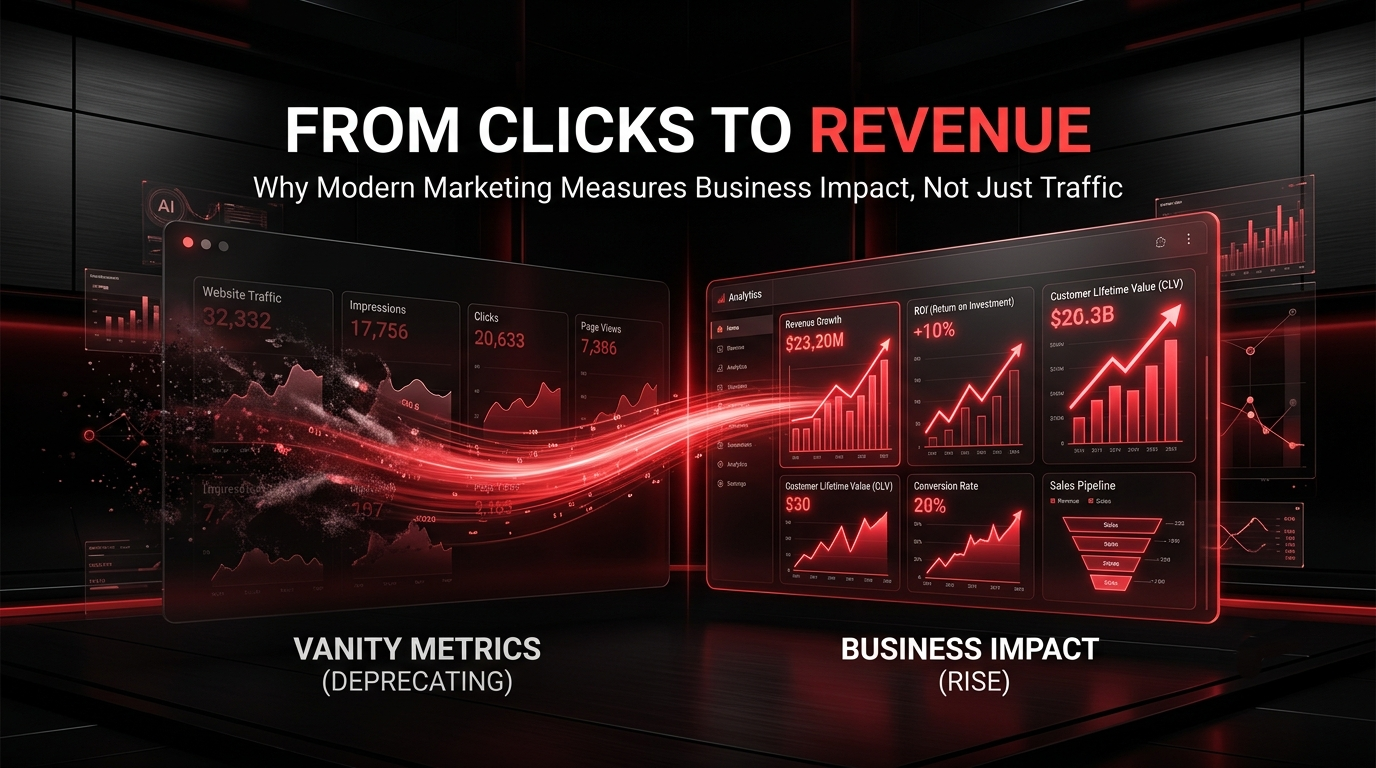
Marketing has entered a new era. One where performance is no longer measured by vanity metrics but by financial impact.
The shift from traffic metrics to revenue metrics is not a trend. It is a strategic correction.
Why Traffic Metrics Dominated for So Long
Traffic was easy to measure.
Tools like Google Analytics made it simple to track sessions, bounce rates, and page views. Social platforms displayed impressions and reach publicly. Agencies showcased numbers that looked big and impressive.
Traffic became the language of success.
But traffic alone tells you only one thing. People visited. It does not tell you whether they converted, purchased, or returned.
A website with 100,000 visitors and low conversions is less profitable than one with 10,000 high-intent users.
Volume without value is noise.
The Problem with Vanity Metrics
Vanity metrics create a false sense of progress.
Impressions can grow, engagement can rise, and leads can increase, yet revenue may remain unchanged.
When marketing teams focus only on traffic, they often:
- Optimize for clicks instead of quality
- Target broad keywords with low purchase intent
- Invest in campaigns that inflate visibility but not profitability
- Miss alignment with sales objectives
This disconnect creates friction between marketing and sales teams.
And leadership begins to ask harder questions.
Where is the ROI?
The Rise of Revenue-Driven Marketing
Modern marketing is performance-driven.
CMOs are now accountable for pipeline contribution and revenue growth. CFOs expect measurable impact. Founders demand predictable results.
This shift has led to a new focus on revenue metrics such as:
- Customer acquisition cost
- Customer lifetime value
- Conversion rate
- Revenue per channel
- Marketing-attributed pipeline
- Return on ad spend
Revenue metrics force clarity. They connect effort to outcome.
Instead of asking, “How many visitors did we get?”
The smarter question becomes, “How much revenue did this campaign generate?”
How Revenue Metrics Transform Strategy
When revenue becomes the north star, everything changes.
Content strategy shifts toward buyer intent. Instead of writing broad informational blogs, brands create bottom-of-funnel content that answers purchasing questions.
Paid advertising becomes more precise. Instead of optimizing for clicks, campaigns optimize for conversions and sales.
SEO becomes more strategic. Rather than targeting high-volume keywords, marketers prioritize keywords with commercial intent.
Even branding evolves. Messaging aligns with value propositions that directly influence buying decisions.
Revenue-focused marketing drives smarter decisions because it ties performance to profitability.
Data Integration Is the Key Enabler
The shift toward revenue metrics became possible because of better data integration.
CRM systems like Salesforce and marketing platforms now connect user journeys from first click to final purchase. Attribution models provide deeper insight into which channels influence conversions.
This transparency eliminates guesswork.
Marketers can now see:
- Which blog drives qualified leads
- Which campaign closes deals
- Which channel produces high-value customers
Marketing is no longer creative guesswork. It is commercial intelligence.
Balancing Traffic and Revenue
This shift does not mean traffic is irrelevant.
Traffic is still the entry point. Without visibility, there is no opportunity. However, traffic must serve a purpose.
The real objective is profitable traffic.
Quality over quantity.
Marketing success today depends on attracting the right audience, nurturing them effectively, and converting them efficiently.
Revenue metrics ensure alignment with business goals. Traffic metrics support awareness, but revenue metrics drive sustainability.
The Role of Agencies in This Transition
Businesses need strategic partners who understand this evolution.
At Webfolks, we approach marketing through a revenue-first lens. Traffic is not the endpoint. It is a stepping stone.
We design campaigns that connect:
- SEO strategy with conversion optimization
- Paid media with measurable ROI
- Content marketing with pipeline growth
- Branding with commercial positioning
Our focus remains clear. Every campaign must contribute to measurable business outcomes.
Because growth is not about how many people visit your website. It is about how many customers trust you enough to buy.
The Future of Marketing Measurement
Marketing is entering a maturity phase.
AI-driven analytics, predictive modeling, and performance dashboards are enabling even more precise revenue tracking. Companies that adapt to this shift will build sustainable competitive advantages.
Those who cling to vanity metrics will struggle to justify budgets.
The future belongs to marketers who speak the language of business.
Revenue.
Final Takeaway
Traffic builds visibility.
Revenue builds companies.
The shift from traffic metrics to revenue metrics reflects a broader evolution in marketing accountability. It forces alignment with sales, leadership, and long-term growth goals.
Modern marketing is not about being seen. It is about generating measurable impact.
If your dashboards still celebrate clicks more than conversions, it may be time to redefine success.
Because in today’s competitive landscape, performance is not measured in visits.
It is measured in value created.