Most service pages look impressive but fail to convert.
They describe services, list features, and highlight internal capabilities. Yet they miss the most important factor that drives action in digital environments.
Human psychology.
A service page is not a brochure. It is a decision architecture where visitors evaluate credibility, relevance, and risk within seconds. Every headline, layout choice, proof element, and call to action influences whether a visitor moves forward or exits.
Conversion is not accidental. It is engineered.
Why Most Service Pages Underperform
When someone lands on your service page, they are not evaluating your company history. They are evaluating whether you understand their problem and whether you can solve it effectively.
The brain scans for clarity immediately. If your messaging feels vague, overly technical, or self-focused, uncertainty increases. Uncertainty leads to hesitation. Hesitation delays conversion.
High-converting pages eliminate that hesitation by aligning structure, messaging, and proof into one cohesive decision journey.
This is where strategy matters more than aesthetics.
Clarity Is the First Psychological Trigger
Clarity reduces cognitive load and signals competence instantly.
Visitors should understand what you offer, who it is for, and what outcome they can expect within seconds of landing on the page. When clarity is delayed, trust weakens.
Strong service pages define the problem clearly before presenting the solution. They use structured headings, outcome-driven language, and benefit-focused positioning to guide attention.
Clarity builds confidence. Confidence builds action.
Relevance Creates Emotional Alignment
Conversion increases when visitors feel understood.
Generic descriptions weaken engagement because they lack specificity. Effective service pages address the exact challenges the audience faces and articulate outcomes in measurable terms.
Instead of saying you provide marketing services, explain how you help B2B companies increase qualified lead generation through data-driven strategy and performance optimization.
Specificity signals expertise. Relevance strengthens credibility.
Authority Reduces Perceived Risk
Every service decision involves uncertainty. Visitors want evidence that your expertise translates into measurable results.
Authority elements such as case studies, testimonials with metrics, structured process explanations, certifications, and industry insights reduce skepticism.
When authority is visible, the visitor’s mindset shifts from doubt to evaluation.
The page moves from descriptive to persuasive without aggressive selling.
Structured Flow Drives Conversion
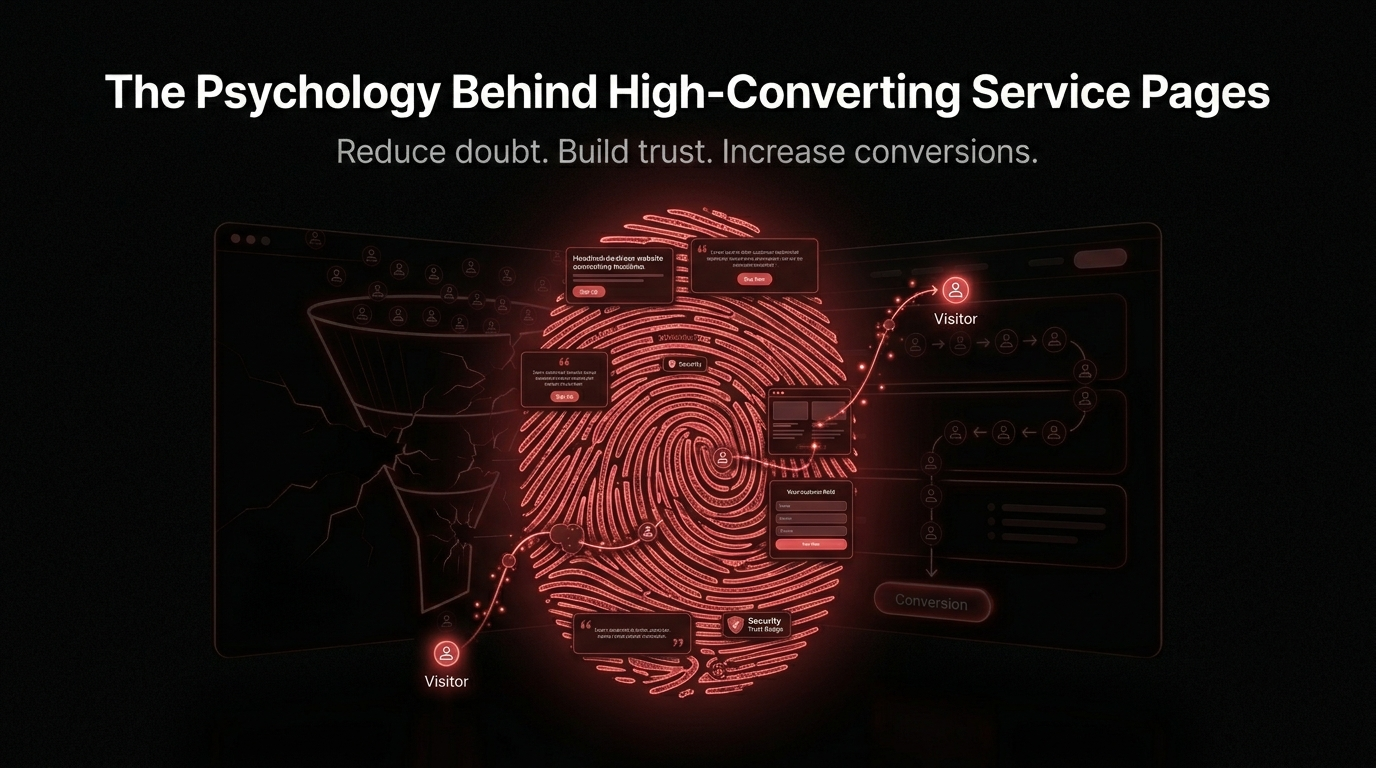
High-converting service pages follow a psychological sequence.
They begin with problem identification, move into solution clarity, reinforce credibility through proof, address objections proactively, and conclude with a confident call to action.
This flow mirrors how people naturally make decisions.
Random content blocks create friction. Structured narrative builds momentum.
Design and User Experience Influence Trust
Psychology is not limited to words. Website speed, mobile responsiveness, visual hierarchy, and clean design influence credibility within seconds.
A cluttered interface signals disorganization. Slow loading times signal unreliability. Seamless navigation communicates professionalism.
Design either strengthens trust or weakens it instantly.
Where Webfolks Creates Impact
At Webfolks, we approach service pages as strategic conversion systems rather than static content pages.
We combine behavioral psychology with digital performance strategy to design pages that do more than inform. They influence decisions.
Our approach integrates:
- Strategic website design aligned with brand positioning
- Conversion-focused UX that reduces friction
- SEO-driven content structured for clarity and authority
- Performance optimization to enhance credibility
- Brand positioning strategy that strengthens trust signals
We analyze how visitors interpret your service offering, identify friction points, and restructure messaging to improve psychological alignment.
The goal is not to add more content. The goal is to remove doubt.
The Strategic Advantage of High-Converting Pages
When service pages are built with psychological precision, they work continuously as digital sales assets.
- They qualify leads automatically.
- Sales cycles become shorter and more efficient.
- Perceived authority grows stronger over time.
- Conversion rates increase without relying on aggressive tactics.
Instead of pushing visitors toward action, they guide them logically and confidently.
This is the difference between traffic and revenue.
Building Service Pages That Convert Consistently
Conversion is rarely a traffic issue and almost always a clarity issue rooted in psychological misalignment.
High-converting service pages resolve that misalignment by integrating relevance, authority, and structured user flow.
They transform curiosity into confidence and confidence into action.
At Webfolks, we engineer service pages that function as continuous digital conversion assets.
Because the strongest growth strategy is reducing doubt at every stage.